Mostrando entradas con la etiqueta Medio Oriente. Mostrar todas las entradas

martes, 15 de enero de 2019

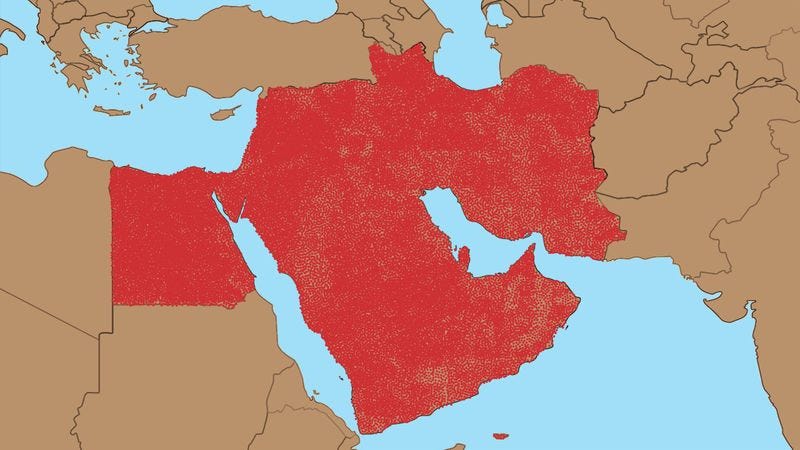
Todos en el Medio Oriente tendrán su propio país en una solución de 317,000,000 estados


NUEVA YORK: Con motivo del último y más ambicioso intento de brindar estabilidad a la región, las Naciones Unidas anunciaron el miércoles que cada persona en el Medio Oriente recibirá su propia nación soberana como parte de una solución histórica de 317,000,000 estados.

El amplio y extenso compromiso, que afecta a más de 3,000,000 millas cuadradas anteriormente ocupadas por los territorios de Israel, Cisjordania, Gaza, Siria, Irak, Irán, Arabia Saudita, Líbano, Omán, Yemen, Egipto y Jordania, se reportará más de 750,000,000 de nuevas fronteras en lo que los expertos afirman ayudarán a frenar drásticamente la violencia sectaria.

"Dado el panorama sociopolítico increíblemente complejo y volátil en todo el Medio Oriente, una solución de 317,000,000 estados es el único medio realista para lograr una paz duradera", dijo Eugène-Richard Gasana, presidenta del Consejo de Seguridad de la ONU, y señaló que el tratado fue alcanzado después de largas negociaciones. que reunió a cada una de las más de 300,000,000 facciones independientes. "Nos complace llegar finalmente a un acuerdo que, con suerte, estabilizará a toda la región y satisfará adecuadamente las demandas de todas las partes".

“Confiamos en que con cada hombre, mujer y niño que posea su propia área autónoma de soberanía para correr como él o ella considere oportuno, evitaremos muchos de los conflictos que han plagado esta parte del mundo durante siglos y han generado innumerables muertos ", agregó Gasana. "Este es un nuevo futuro brillante para el Medio Oriente".

Según los funcionarios de la ONU, el Medio Oriente recientemente demarcado consta de 8,000,000 estados judíos independientes, 4,000,000 estados palestinos independientes, 112,000,000 repúblicas islámicas chiítas, 156,000,000 repúblicas islámicas sunitas y 19,000,000 naciones kurdas, así como aproximadamente 18,000,000 territorios que incluyen varios , Bahá'í, Drusos, Zoroastristas, y los países seculares.

Según los informes, el tratado se ha reunido en gran parte con el apoyo de los lugareños, y muchos elogiaron la división de la región en casi un tercio de mil millones de estados soberanos como una solución práctica y desesperadamente necesaria después de décadas de incesantes combates sectarios.

"Francamente, dar a cada uno de los ciudadanos de Oriente Medio un país propio hace mucho tiempo que se debió realizar", dijo Naseer Khalidi, de 49 años, a periodistas desde su recién formado estado independiente de 400 pies cuadrados a lo largo de la antigua Cisjordania, que se encuentra junto a Naciones pobladas por su esposa y sus dos hijos. “Después de una historia tan larga de violencia y discordia, ahora tenemos una región que está dividida de manera justa y equitativa entre todas las facciones religiosas, grupos étnicos y habitantes individuales. Finalmente, todos podemos vivir sin opresión ".

Sin embargo, la resolución no ha estado exenta de varias complicaciones, ya que la ONU está luchando por acomodar a sus 317,000,183 estados miembros, y la economía global aún debe incorporar cada una de las 317,000,000 formas de moneda completamente nuevas.

Los informes también confirmaron que varios cientos de nuevos estados en lo que antiguamente era el noreste de Arabia Saudita contienen reservas de petróleo muy valiosas dentro de sus fronteras, con altos funcionarios en esas naciones que ya han recibido una serie de visitas diplomáticas de los Estados Unidos y Europa Occidental, lo que generó tensiones. Sus decenas de miles de países vecinos.

"Si bien esta idea puede funcionar en teoría, este es simplemente otro plan miope que solo aumentará las tensiones en la región", dijo el ex residente sirio de 54 años de edad, Ilyas al-Masry, y agregó que ya ha habido algunos indicios de inquietud. entre cada uno de los 246 estados soberanos dentro de un radio de 5,000 pies de su país. "¿Cómo podemos tener estabilidad y paz cuando más de 300,000,000 naciones habitan tierras que no tienen absolutamente ningún derecho de ocupar?"

"Mientras todos respeten mis fronteras, no habrá problemas", agregó al-Masry. "Pero estoy preparado para usar la fuerza si hay algún intento de desestabilizar o infringir a mi nación".

En el momento de la publicación, los informes confirmaron el estallido de más de 90,000,000 nuevas guerras en la región, con fuentes que estiman la cifra actual de muertes en aproximadamente 700,000.

Fuente: The Onion (Página de sarcasmo)

domingo, 20 de diciembre de 2015

The Iranian Republic's Biggest Problem:


By: Joseph Amoroso.

In reviewing any potentially conflicting constitutional issues, I find us in a situation where we will face difficulties dealing with the immediate threats now confronting us at our borders and in the surrounding area.  There are forces at work that require us to modify our stance towards the West, but  the strict requirements of our Constitution may slow down any efforts to bring about a major shift in our approach -- at a time when it is vital that we create a common front to destroy the Islamic State (Daesh).

The current situation in the Middle East presents us with many challenges, all of which have the potential to affect us negatively.  Among these are the rise of Daesh, oil price pressures, The Gulf States' anti-Shia paranoia, and the West's fear of Iranian nuclear and military capabilities.  Similarly, we are surrounded by ongoing conflicts and several of our key partners are threatened by them.  If Daesh is successful, they will target our interests in Lebanon, Syria and Iraq and eventually Iran itself (1).  We must take drastic actions to preserve our Revolution.

The situation confronting us did not come from us.  Miscalculations by the U.S., Europe and Israel have created these crises, but their potential effects require that we do all we can to help defuse them -- and we can only do so in concert with these new "allies".  Otherwise, Daesh, Sunni irredentists in the Gulf States and who have come to power in the Arab Spring, Israel, and Christian fundamentalists in the West will rush headlong into an impasse that can only affect us negatively and even mortally.  If Assad falls, our Shia allies in Lebanon will suffer and both Israel and Daesh will be able to isolate and destroy them.  Sunni fundamentalists will gain power in the Arab Middle East, and the Palestinian cause will be lost.  Furthermore, oil markets will be destabilized and OPEC will fall to the wayside.  Our Revolution is at risk.

My Proposed Solution:

There is but one choice open to us at this point and it involves entering into closer military, economic and diplomatic relationships with the U.S. and The European Union.  Given the instability of virtually all of their partners in the Middle East  and the fact that we have many goals in common, there are reasons for the West to try to improve its relations with Iran.  If we do not take these steps, combined internal and external pressures have the potential of putting us in a situation which will threaten the fruits of our Revolution.

We have already begun intelligence sharing with Russia, Iraq and Syria on Daesh (2) and, on 9 April, our Supreme Leader articulated the view that Iran is ready to cooperate with the U.S. on regional issues if the U.S. would indicate some willingness to change its policy. (3)

Proposed Steps:

1) We must send out feelers to the U.S. pointing out these common goals and offering to cooperate as much as possible with this effort.  We can let the U.S. send out similar feelers to its European allies and Russia.  We will also offer our commitment to partner with our Shia allies in this effort and work together to reach an improvement in this situation. 

2) At the same time, if we receive encouraging responses, we will have to start preparing the groundwork for this major shift in policy by courting those who we expect will welcome it and those who will likely oppose it.

3) We must explain to our people that the situation is serious and threatens the stability and future of our Revolution. 

4) We must also explain to to the U.S. and the West that the sacred language of our Constitution forbids us from cooperating with our enemies and allowing them to gain any influence over us or interfere with our Constitutional objectives.  We will not violate any Chapter or Article of the Constitution in making any shift in policy and we expect any potential partners to be aware of their responsibility to adhere absolutely to the principles of our Constitution.  Thus, any shift we make will have to follow the  requirements or our Constitution.

Relevance To The Solution:

The West is now starting to realize that President Assad is their best option and that cooperation with Assad, Russia and Iran offers an opportunity to establish a strong counterbalance to Daesh and the unstable states of the Sunni Middle East. (4)  It is in our interest to take a behind-the-scenes role in this effort and, when the time is appropriate, all actions that we can.

The reality is that the U.S. and Europe are amenable to bringing stability to the Sunni world and defusing the threat from Daesh, that a solution to the Palestinian problem is essential in order to attain this goal, and that Iran and its Shia allies can contribute to these efforts.  Of course, it is similarly advantageous for us to weaken the relationships between the West and the Gulf states and between the West and Israel.

Potential Allies:

It is clear that our people -- once they understand the seriousness of the situation -- would generally welcome a move that will defuse tensions with the West, protect our Revolution, and bring an end to some of the problems above.  When the time is appropriate, we can explain our proposal to the people, the advantages that would fall our way and the potential fallout from failure.  We would expect considerable support from our youth, business community, and education community -- all of whom would benefit from improved relations.  We will need their support in securing the necessary Constitutional approvals for any future policies.

Potential Opponents:

Internally, past relationships with the West have not been beneficial to our country and our revolutionary efforts.  There is a long history of Western efforts to corrupt our officials, sabotage our economy, generate internal conflict and try to gain economic advantages.  In our approaches to the West, we must explain to our people what we expect in future relations with the West; i.e., commitments to not interfere in Iranian internal affairs, not obstruct our efforts to improve our economy and infrastructure, and bring meaningful pressure on Israel to find a rapid solution to the Palestinian problem and to protect Shia interests in Lebanon.

There are many factions in our Country who will try to obstruct any improvements in our relationships with the West.  It will be necessary to consult with all of them as we take this effort forward and convince them that this is in the best interest of our Republic.  Similarly, there are factions in the West that will do everything they can to sabotage any cooperative efforts with us.  Our hope is that they will all see that, otherwise,  Daesh will only continue to destabilize the Middle East and the World in the goal of bringing their caliphate to its desired apocalypse. (5)

Adhering to our Constitution, we will secure the cooperation and support of the Islamic Consultative Assembly, the Leadership Council, the Executive, the Judiciary and the Supreme Council for National Security and -- through them -- the support of our people in moving forward towards this objective.

---------------------------------------------------------------------------------
(1) https://www.wilsoncenter.org/article/rival-islamic-states-isis-v-iran-0
(2) http://foreignpolicy.com/2015/09/28/russia-iran-iraq-and-syria-to-share-intelligence-on-islamic-state/
(3) http://www.commondreams.org/views/2015/09/10/why-us-and-iran-arent-cooperating-against-isis
(4) http://www.theguardian.com/us-news/2015/jan/25/us-syrian-regime-change-isis-priority
(5) http://www.theatlantic.com/magazine/archive/2015/03/what-isis-really-wants/384980/